

Supplier research & selection
We identify the factories best suited to your product and shortlist the most reliable partners against your criteria for price, quality and capacity.
- Market mapping
- Qualified shortlist
- Structured comparison
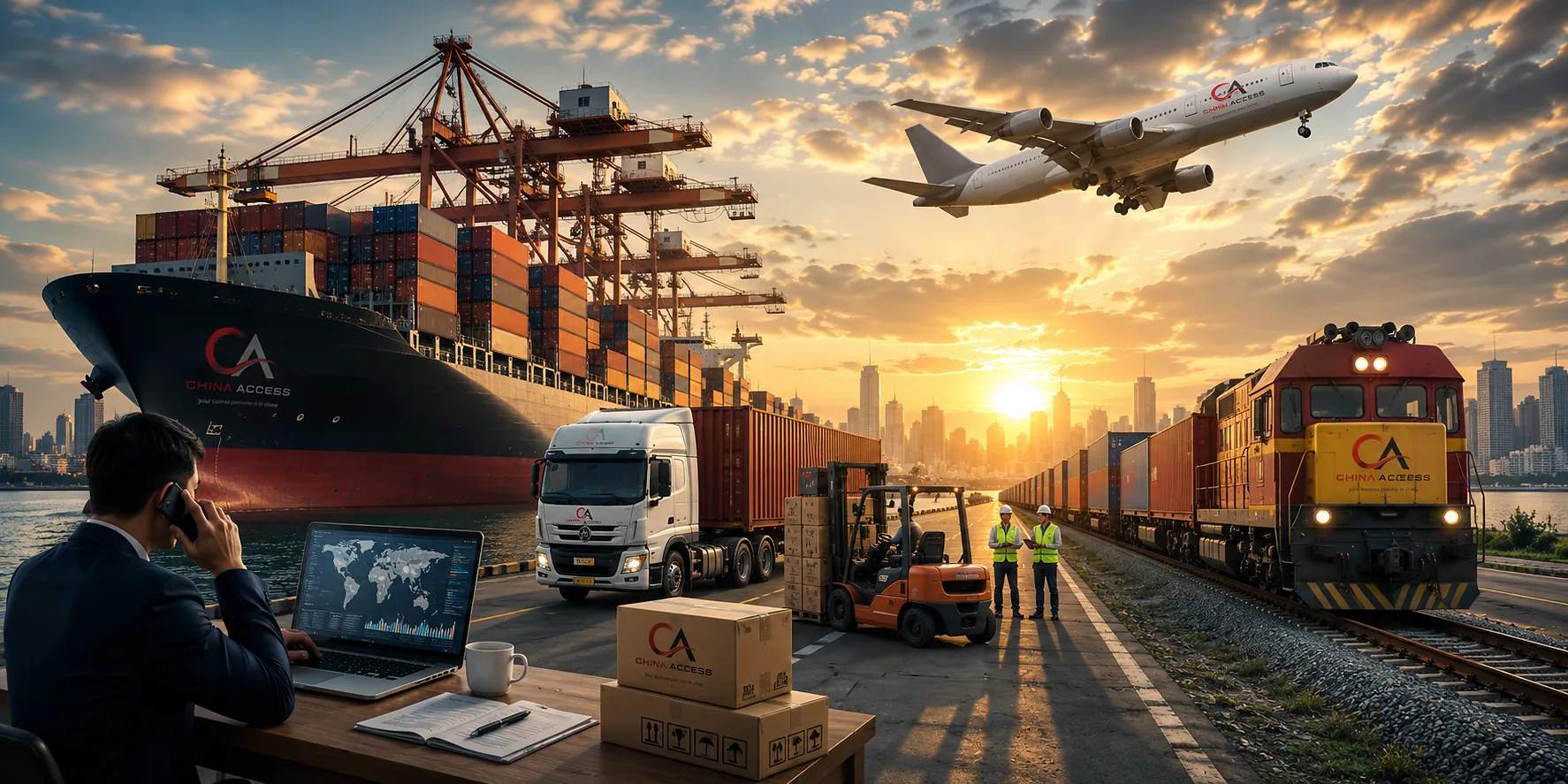
From finding suppliers to quality control and international freight, China Access secures every stage of your purchasing in China, with an operations team on the ground.
China Access is a sourcing and business support partner in China. We act as your local representative: we find the right suppliers, negotiate on your behalf, control quality and arrange logistics all the way to destination.
Our team is based in China itself, dealing directly with suppliers we have vetted and shortlisted. China Access becomes your single point of contact and opens the door to a broad range of business with China.
Our role is to save our clients time, reduce the risks of buying abroad and secure every order, with complete transparency and personal follow-up.
A team in China, close to the factories and the suppliers.
Vetted suppliers and quality checked at every stage.
A single point of contact, from first enquiry to delivery.
Each service can be used on its own or built into end-to-end support, depending on your project.
We identify the factories best suited to your product and shortlist the most reliable partners against your criteria for price, quality and capacity.
Checks on licences, financial soundness and legitimacy before you commit, to weed out middlemen and put your trading relationship on safe ground.
We negotiate on your behalf, in the local language and business culture, to secure the best pricing, lead times and payment terms.
From idea to finished product: prototyping, samples, customisation, packaging and a technical specification suited to your market.
Inspections before, during and after production, with detailed reports and photographs, to confirm your orders conform before they ship.
Consolidation of goods and shipment by sea, air or rail, with customs assistance through to destination.
Centralised tracking of your orders, coordination with suppliers and regular reporting, for full visibility from start to delivery.
Representation at trade fairs, factory visits and support on the ground in China, with interpreting and strategic purchasing advice.
A partnership built for the long run: we track your performance, watch how your niches evolve and advise you on your next decisions.
A clear, proven process that turns your ideas into working projects, with no unpleasant surprises.
We study your project, your constraints and your objectives to draw up a precise specification.
Identifying, vetting and shortlisting the suppliers best matched to your product.
Negotiating price and terms, approving samples and framing the order.
Inspecting production and confirming conformity before anything ships.
Consolidation, international freight and customs assistance through to your destination.
Receipt, project review and ongoing support for your next orders.
We combine local proximity, knowledge of the Chinese market and operational rigour to defend your interests.
A team on the ground who speak the language, know the factories and travel on your behalf.
Supplier vetting and quality control to secure every stage of your purchasing.
Better terms, won through command of local business culture and the market.
A single point of contact who coordinates the whole project for you.
Clear reporting, inspection reports and regular communication throughout.
Personal support, with clear and prompt answers.
From catalogue products to bespoke development, every industry has its own standards, its production regions and its pitfalls.
CE, RoHS and REACH compliance for electronics, resistance testing and certified materials for furniture, cosmetics regulation for personal care, safety and marking rules for children’s items: requirements change from one category to the next, and so do the factories able to meet them. That is what guides our selection.
Don’t see your product listed? Tell us about your project.
Describe what you need: product, quantity, objectives. We will get in touch to talk it through.
Answers to the questions we are asked most about sourcing, importing and quality control in China.
Another question? Get in touch.
MOQ depends on the product, the material and the factory: a few dozen pieces for a simple catalogue item, often several hundred as soon as a mould, a specific colour or bespoke packaging is involved. We look first for manufacturers whose scale matches your volume, rather than negotiating an exception to an MOQ that is too high — a supplier who accepts an order outside its usual range rarely treats it as a priority. Where it makes sense, we negotiate a smaller first run so you can test the market before committing to larger volumes.
The timeline depends entirely on the product: supplier research and sample approval can move quickly on a standard item, and take several rounds as soon as a mould, a particular material or bespoke packaging is involved. Production follows the same logic, according to the complexity of the piece and the factory’s workload when the order is placed. Only transport can be forecast with any regularity, as an indication: two to three months by sea, around thirty-five days by road, one month to forty-five days by rail, ten to fifteen days by air. That is exactly where we come in: once we have analysed your requirement, we draw up a precise schedule with you, from launch to delivery, factoring in Chinese New Year and National Day, then keep you informed at every step.
We step in at three points: before production, to approve materials and the reference sample; during manufacturing, once 20 to 30% of the units are off the line, so that a defect can be corrected while it is still fixable; and before shipment, on a random draw following AQL levels. Every inspection produces a detailed photographic report covering measurements, finish, markings and the conformity of packaging and labelling. You release the shipment on the strength of that report, never on the supplier confirmation alone.
Common practice in China remains a 30% deposit on order and a 70% balance before shipment, against a copy of the bill of lading. We help you secure a balanced payment schedule, never settle an order before the inspection report, and check that the beneficiary bank account matches the entity named on the invoice: fraudulent changes of bank details are the most frequent risk on this market. Terms are still agreed case by case with the supplier, and we do not provide guaranteed financial or legal advice.
Yes. We arrange consolidation, groupage when your volume does not fill a container, and shipment by sea, air or rail to destination. We prepare the documents required for clearance — commercial invoice, packing list, bill of lading, certificate of origin — and check that the customs code applied genuinely matches the product, which is what determines your duty rate. Final assessment of duties and import VAT rests with the authorities in your country and with your customs broker.
In the great majority of cases, yes. Send us a sample, a photograph, a link or a specification: we identify the industrial clusters specialised in your product category, then run a tender among the relevant manufacturers. Supplier research is carried out directly with the factories: we rule out traders presenting themselves as manufacturers, and verify production capacity, export experience and the certifications your market requires. You receive a structured comparison — unit price, MOQ, monthly capacity, production lead times, standards covered — and you choose on comparable terms, not on promises.
Yes. With ODM we start from a product already in the factory range and adapt it: colour, material, dimensions, logo, packaging under your brand. With OEM we develop your product from your drawings or your specification, with prototyping, successive samples and approval before launch. Bespoke development usually involves tooling costs and a higher MOQ: we cost these from the outset so the decision is taken with full visibility, and we set out in writing who owns the moulds and the technical files.
Your documents, drawings and commercial information are treated in confidence and passed to suppliers only at the level of detail strictly needed to obtain a quotation. We can formalise this commitment with a non-disclosure agreement before any exchange, and have the factories consulted sign an equivalent undertaking on sensitive projects. For a genuinely novel product, we recommend protecting your rights in your own market before production begins: intellectual property is a matter for specialist advisers, whom we do not replace.
Online marketplaces give access to thousands of listings, but a significant share of the accounts belong to traders rather than factories: you pay an intermediary margin without gaining any security. An agent based in China visits the workshop, verifies the legal existence of the company, negotiates in the local language and conventions, and inspects the goods before they leave the country. The difference shows most clearly when something goes wrong: a complaint handled on the ground gets resolved, a complaint handled from a distance gets lost.
The factory price is only part of the landed cost. On top of an FOB price come international freight, insurance, terminal and handling charges, clearance, the duty rate attached to your product code, import VAT and final delivery. Depending on value and volume, these items commonly add 15 to 40% to the purchase price, more for bulky low-value goods where freight weighs heavier than the product itself. We build this calculation with you before the order, so the decision rests on landed cost rather than on the quoted price.
These Incoterms define where the seller responsibility ends. Under EXW the goods are collected at the factory and everything beyond that falls to you. Under FOB the supplier delivers and clears the goods for export at the Chinese port: it is the most common basis and the clearest for comparing two quotations. Under CIF the supplier adds freight and insurance to the port of arrival, often at a rate less favourable than your own. Under DDP everything is included to your door, duties paid. Comparing two prices quoted on different Incoterms is meaningless: we always bring offers back to a common basis.
We start with legal existence: business licence, unified registration number, registered capital, date of incorporation and declared scope of activity — a company authorised for trading alone cannot be the factory it claims to be. We then verify the certifications relevant to your market (CE, RoHS, REACH, FDA depending on the product) with the issuing bodies, not on the strength of a PDF document. Finally, the site visit remains decisive: production lines genuinely running, headcount, raw material stock, working conditions. Many discrepancies only become visible on site.
Yes. A first import is prepared differently: smaller volumes, a single product, and less room for error because one failed order weighs heavily. In that case we favour suppliers used to short runs, a trial order before any volume commitment, and closer guidance on documents and clearance, often encountered for the first time. The method stays the same for an experienced importer as for a first order: the same checks, scaled to your project.
Yes. We prepare your visit in advance — selecting the relevant halls and exhibitors, booking meetings, drawing up the technical questions to ask — then accompany you on site with interpreting and negotiation support. Outside the fair, we arrange factory visits grouped by region to make the trip worthwhile. If you cannot travel, we go in your place and send you samples, photographs and comparisons. The Canton Fair is held twice a year in Guangzhou, in spring and autumn, and bookings are made several weeks ahead.
Chinese New Year falls between late January and mid-February, following the lunar calendar. Factories officially close for a week, in practice two to four, and output slows for several weeks beforehand as order books fill and suppliers prioritise their regular customers. The restart is just as delicate — some workers do not return from their home province, and the first batches produced by renewed teams call for closer quality control. In practical terms, an order due before Chinese New Year is placed in the autumn. National Day, from 1 to 7 October, has a similar but shorter effect.
Yes, and it is a step worth taking. A catalogue sample usually ships within a few days; a sample modified to your specification takes one to three weeks, longer if a prototype or a mould is required. Factories generally charge for the sample and its express shipping, an amount often credited against the first order. What matters most comes next: the approved sample becomes the reference sample, signed and kept by both parties. It is the basis for pre-shipment inspection. Without that written reference, a dispute over a finish or a shade has nothing to stand on.
A 20-foot container holds roughly 33 m³ of usable space, a 40-foot around 67 m³, a 40-foot high cube around 76 m³. Below those volumes, groupage — LCL — lets you share a container with other shippers: billing is per cubic metre or per tonne, whichever is less favourable. Watch the destination charges, often underestimated — deconsolidation, handling, storage — which can wipe out the saving. As an order of magnitude, a full container often becomes the better option from thirteen to fifteen cubic metres upwards. We compare both scenarios against your actual volume before deciding.
Everything starts with the product classification code: six digits harmonised worldwide, extended to eight and then ten digits in the European Union. That code determines the applicable rate. Duties are calculated on the customs value, which generally includes the price of the goods, transport and insurance up to the border. Import VAT then applies to that total plus duties; it is in principle recoverable by a VAT-registered business, which is never the case for duties. Some Chinese products also carry anti-dumping duties, occasionally very high. Classification is the importer’s legal responsibility: we check it, your customs broker confirms it.
The importer — and many find out too late. For most product families, CE marking is a manufacturer’s declaration, not a certificate issued by a body. By placing a product from a non-EU country on the European market, you take on most of the manufacturer’s obligations: confirming that conformity assessment was actually carried out, holding the EU declaration of conformity, being able to produce the technical documentation — generally kept for ten years — and putting your name and address on the product or its packaging. A CE logo printed on a carton proves nothing. We gather these elements at source; validating them is a matter for your adviser or the relevant body for that product category.
Price is never a standalone figure: it depends on quantity, the exact material, thicknesses, packaging, lead times and payment terms. Hence the most common trap — securing a discount without changing anything in the specification. The factory agrees, then compensates by substituting a cheaper component, material or surface treatment, without mentioning it. Useful negotiation therefore bears on the technical sheet, not on the number alone: you fix the specification in writing, then discuss price at constant specification. A quotation well below the others almost always signals a difference in materials, not better productivity.
Prevention counts for more than remedy. A contract enforceable in China is written in Chinese, names the entity by its registered legal name — the one on the business licence, not the trading name — and bears the company’s official red seal: in practice that seal binds more firmly than a signature. A clause granting jurisdiction to a foreign court often remains difficult to enforce locally. For ordinary amounts, the real leverage is not judicial: it is the unpaid balance and pre-shipment inspection, which leave room to correct matters while the goods are still in the country. We frame these points upfront; an actual dispute is a matter for a lawyer.
Technically yes, and shipping from China to a European fulfilment centre is common practice. Two conditions deserve attention. First, the platform never acts as importer: you must hold an EORI number and a VAT registration in the destination country, and appear as the consignee for customs clearance. Second, labelling must comply before departure — product references, carton labels, weight and dimension limits specific to the network — because a non-compliant parcel is refused or charged for reprocessing. Finally, direct delivery removes any intermediate inspection: pre-shipment control becomes your only window to verify the goods.
Fill in the contact form with as much detail about your project as you can. We will get back to you as quickly as possible.